
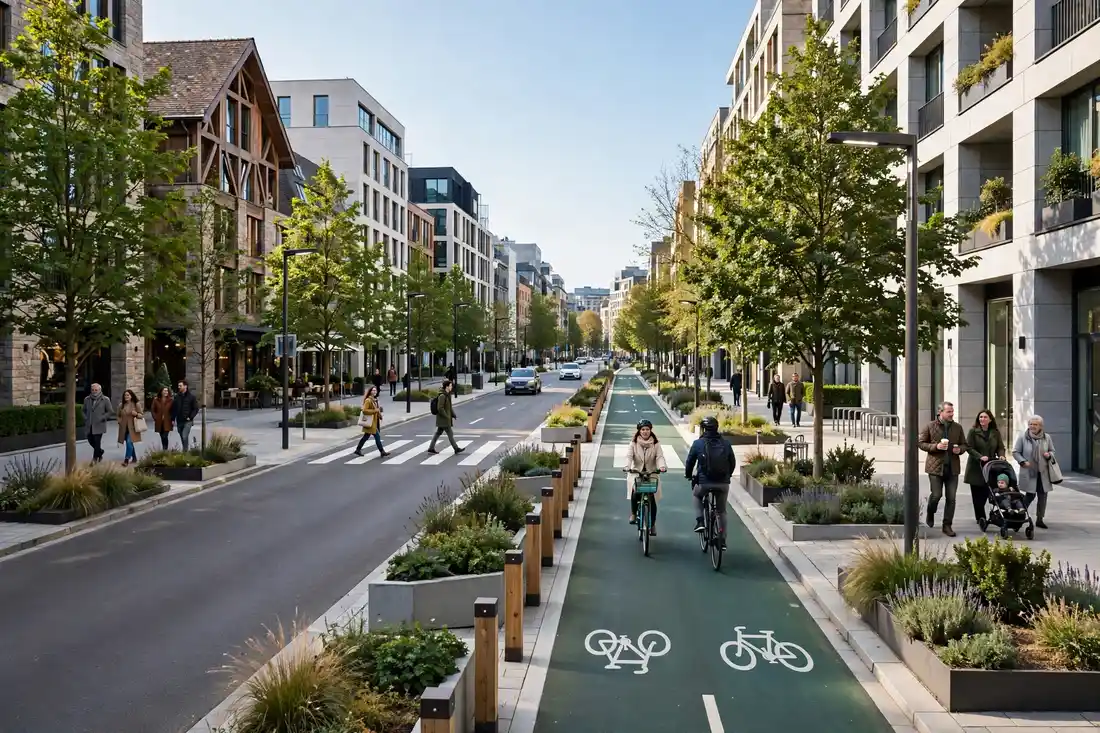
Most road danger is not really about bad luck. It is designed in — or designed out — long before anyone drives, cycles or walks along a street. When metro cities design roads with safety in mind, the layout itself slows traffic at the right moments, gives people on foot and on bicycles their own protected space, and makes everyone’s next move predictable. This guide explains the core principles of road safety design: safer junctions, proper crossings, good lighting, speed managed by design rather than by signs alone, and the maintenance that keeps a well-designed street working.
Junction Design: Where Safety Is Won or Lost
Junctions are where traffic movements cross each other, which makes them the places where design matters most. Safe junction design starts with simplicity: the fewer conflicting movements a driver, cyclist or pedestrian has to process at once, the better. Tighter corner radii force vehicles to turn slowly instead of sweeping around corners at speed. Clear sight lines, kept free of parked cars, hoardings and overgrown planting near corners, let everyone see each other in time. Raised junction treatments and continuous footways across side streets send a clear message about who has priority, and compact junction layouts shorten the distance pedestrians spend in the carriageway. None of this requires exotic technology — it requires treating the junction as a place for people first and a traffic pipe second.
Crossings People Actually Want to Use
A crossing only improves safety if people use it, and people use crossings that sit where they naturally want to walk. Good design therefore places formal crossings on desire lines — outside station entrances, schools, markets and bus stops — rather than expecting pedestrians to detour. Signalised crossings need waiting times short enough that people do not give up and cross on red. Countdown displays, where they are used, help by removing the uncertainty about how long the wait will be, which is often what tempts people to take a chance. Refuge islands let pedestrians cross wide roads in two stages, dealing with one direction of traffic at a time. Dropped kerbs and tactile paving make crossings usable for wheelchair users, people with prams and those with visual impairments. The principle running through all of this is that safety design should match real human behaviour, not demand superhuman patience from the people most at risk.
Separated Space for Cycling and Walking
Mixing fast, heavy traffic with people on bicycles is a design choice, and increasingly cities are choosing differently. Protected cycle lanes — separated from motor traffic by kerbs, barriers or parked cars rather than paint alone — make cycling feel safe enough for people who would never ride in general traffic. The same logic applies to pavements: wide, unobstructed footways that are not colonised by parking, bins and signage keep pedestrians out of the carriageway. Where separation is impossible, design should reduce the speed and volume of traffic until mixing becomes genuinely comfortable. These choices also support the everyday roadworthiness culture that keeps vehicles themselves safer — regular checks of the kind covered in our essential vehicle maintenance guide for UK car owners matter even more when vehicles share space with vulnerable road users.
Speed Management by Design
Signs and cameras have their place, but the most reliable way to make traffic slower is to design streets where driving fast feels wrong. Narrower traffic lanes, street trees, build-outs at crossings, changes of surface and well-placed bends all communicate the right speed to drivers instinctively. This matters because speed shapes both the likelihood of a collision and its severity: slower traffic gives everyone more time to react, and if a collision does happen, the energy involved is far lower. Residential streets and shopping areas benefit most visibly, but the principle extends to how vehicles are kept and driven day to day — the standards in our complete guide to car servicing for UK drivers and the checks in our complete UK guide to safe car tyres are the vehicle-side half of the same safety picture, since brakes and tyres decide how short a stopping distance really is.
Some of the most effective safety design is temporary and human in scale. School streets — where traffic is restricted at drop-off and pick-up times — remove the most chaotic conflict of the day entirely rather than trying to manage it. Play streets and parklets reclaim small pieces of carriageway for people, proving to residents that a street can serve purposes beyond traffic. Even where permanent reconstruction is years away, trials with planters, paint and movable barriers let a city test a safer layout cheaply, measure how traffic actually responds, and build public support before committing to construction. The lesson repeats across successful schemes: design that starts from the experience of a child, an elderly person or a wheelchair user tends to end up safer for absolutely everyone, including drivers.
Lighting, Visibility and Maintenance
Good design fades quickly without upkeep. Street lighting should prioritise crossings, junctions and bus stops — the places where people on foot are most exposed — and should let drivers judge shapes and movement rather than simply flooding a road with glare. Visibility splays at junctions need defending against parked vehicles and new obstructions year after year. Surfaces matter too: potholes, worn markings, faded zebra stripes and slippery drain covers all quietly undo the safety a design promised, and cyclists and motorcyclists feel poor surfaces first. A serious safety culture also extends to the vehicles using the road, which is why buyers looking at older cars benefit from guides like our complete guide to buying used cars in the UK, where safety equipment and condition can be checked before purchase.
Designing metro city roads with safety in mind is not about any single scheme. It is a habit of asking, at every junction, crossing and street, what could go wrong for the most vulnerable person using it — and designing that failure out before it happens. Cities that take this approach discover that safer streets are also more pleasant ones: calmer, greener and easier for everyone to use, whatever their mode of transport.