
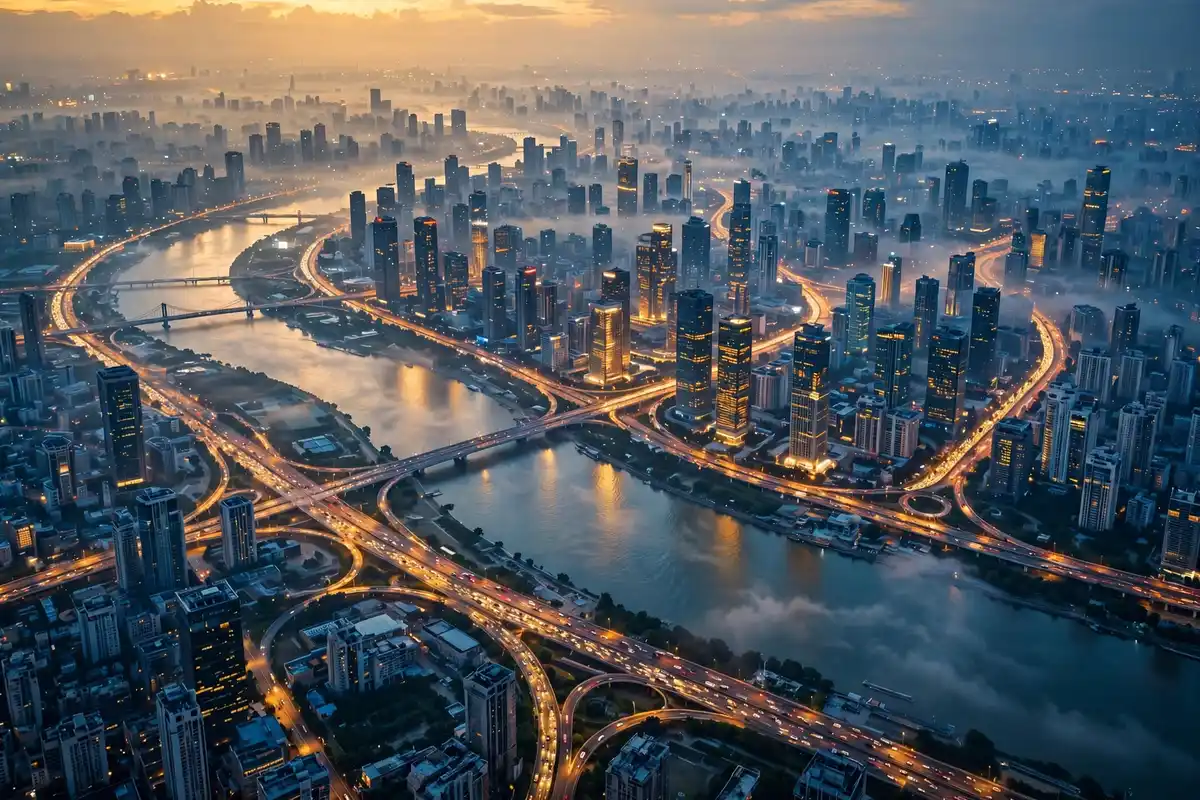
Megacities are the giant urban regions that have come to define how a growing share of humanity lives. The term is not just journalistic colour: geographers and the United Nations use megacity for a city whose population passes ten million people. By that measure the world has moved in a few generations from a handful of such places to dozens of them, concentrated increasingly in Asia, Africa and Latin America. This guide explains what a megacity actually is, how these vast urban areas grow, what daily life inside them feels like, and why some cope with their size far better than others.
What Counts as a Megacity?
The working definition is a population of more than ten million. That number usually refers not to the historic city centre but to the wider metropolitan area — the continuously built-up region whose residents work, shop and travel across it every day. This matters when comparing cities, because administrative boundaries vary enormously: some city governments govern only a dense core, while others administer an area the size of a small country. Tokyo is generally counted as the largest urban agglomeration in the world, and names such as Delhi, Shanghai and São Paulo regularly appear alongside it at the top of the rankings. What they share is not a skyline style or a culture but sheer scale: more people in one connected urban system than many entire countries contain.
How Megacities Grow
Megacities grow through a combination of migration and natural increase. People move from rural areas and smaller towns looking for work, education, healthcare and opportunity that smaller places cannot always provide. Once a city reaches a certain size, its economy tends to generate its own momentum: employers cluster where the workforce is, services cluster where the customers are, and each new arrival makes the city marginally more attractive to the next. Births within the city then add further growth on top of migration. The result, in the fastest-growing cases, is a city adding the population of a medium-sized town every year. Growth at that pace explains both the energy of megacities and their most visible problems, because housing, roads and pipes cannot be built as quickly as people arrive.
Daily Life at Enormous Scale
For residents, life in a megacity is a study in contrasts. The same city can offer world-class hospitals, universities and restaurants alongside neighbourhoods where water supply and sanitation are still catching up. Commuting dominates many people’s routines: metro systems, suburban railways, buses and vast informal networks of minibuses and motorbikes move millions of people each morning and evening, and journey times shape where people choose to live and work. Visitors get a gentler version of this intensity. Travelling through a huge city rewards the same habits that help in any big destination — our beginner-friendly advice in solo travel tips for beginners applies just as well to a first weekend in a megacity as anywhere else.
There is also a cultural density that smaller places cannot match. A megacity contains whole districts given over to single trades, cuisines from every region of the country and beyond, and festivals, markets and street life running at almost any hour. The historic quarters of older giant cities can feel surprisingly human in scale — the quieter corners covered in our guide to places to visit in Paris away from the tourist trail show how even one of the world’s most visited capitals keeps neighbourhood-sized secrets.
Running alongside the formal city is an informal one that visitors often barely notice. Street vendors, repair stalls, unregistered workshops, home-based businesses and casual day labour provide a large share of the goods and services megacity residents actually use, and they are frequently the first rung on the ladder for new arrivals who cannot yet access formal employment or premises. This informal economy is a source of resilience as much as a symptom of strain: it feeds neighbourhoods, keeps prices low and absorbs workers during downturns. City authorities have historically swung between trying to clear it away and learning to work with it, but the most pragmatic megacities increasingly recognise it as part of how the city functions rather than a problem to be eliminated.
The Pressures: Housing, Congestion and Air
Scale brings strains that no megacity escapes entirely. Housing demand pushes up prices and rents, and where formal housing cannot keep pace, informal settlements grow on the edges or in overlooked pockets of land. Traffic congestion wastes time and fuel, and in many megacities air quality suffers from the combination of vehicles, industry and construction. Water supply, drainage and waste collection all have to operate at a scale where a single system failure affects hundreds of thousands of people. None of these problems are unique to megacities — smaller cities know them too — but size multiplies both the difficulty and the consequences of getting them wrong. City governments respond with metro extensions, bus rapid transit, congestion management, slum upgrading programmes and stricter building and emissions rules, with very mixed results from place to place.
What Makes a Megacity Work
The megacities that function best tend to share a few features. Reliable public transport sits at the top of the list: a city of fifteen million cannot move by private car alone, and the great metro and suburban rail networks of cities like Tokyo are as much a part of their success as their economies. Beyond transport, the common threads are competent basic services — water, power, waste collection — extended steadily into newer districts, and enough formal employment to give newcomers a foothold. Many megacities are also collections of distinct centres rather than one downtown, which spreads journeys and gives neighbourhoods their own identity. Travellers planning to experience these places will find starting points in round-ups like our pick of the best places to visit in the United States, while guides to fast-growing Chinese cities such as our complete guide to Quzhou travel and our overview of the best places to visit in Prague show the smaller, older end of the urban spectrum for contrast.
Megacities are not a passing phase. Urbanisation continues worldwide, and the largest cities will keep growing whether planners feel ready or not. The open question is not whether megacities will exist but how liveable they will be — and the difference between the best and worst outcomes comes down to transport, services and governance rising to meet the scale of the city itself. For the billions who already call them home, and the visitors who pass through wide-eyed, that makes megacities some of the most important places on Earth to understand.